
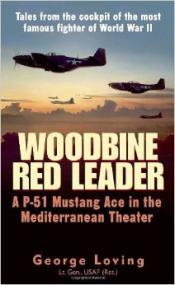
Woodbine Red Leader - Buch
Rezensionen
Es wurden bisher keine Bewertungen abgegeben.
Autor
Buch
Originaltitel
Originalsprache
nicht angegeben
Erstveröffentlichung
2003
Band (Reihe)
-
Typ
Buch
Genre
Biographische Literatur: Autobiographie
Auflage
Sprache
Englisch
Übersetzt von
-
Verlag
Jahr
2003
Seitenanzahl
292
ISBN
089141813X
EAN
9780891418139
Ausgabe
Taschenbuch
Auflage
Unbekannt
Inhalt/Klappentext
A combat ace's account of piloting the greatest single-seat fighter in World War II.
World War II marked the end of an era; fighter pilots still flew by the seat of their pants, and George Loving recaptures the exhilarating world of aerial combat in all its stark terror and fiery glory. His first fighter was the famed Spitfire, hero of the Battle of Britain. By 1943, however, it was obsolete and did not match up well against the first-line German Messerschmitts and Focke-Wulfs. Yet Loving survived 101 combat missions flying the Spitfire. In the spring of 1944, Loving's 31st Fighter Group started flying P-51 Mustangs and was transferred to the new Fifteenth Air Force to escor heavy-bomber formations on long range strategic strikes across southern Europe, including southeastern Germany. In the flak-filled skies over Ploesti, Vienna, Bucharest, Munich, and Stuttgart, where a number of the war's fiercest air battles took place, Lieutenant Loving flew head-to-head against some of the Luftwaffe's top fighter ace's.
By the time George Loving completed his 151st, and final, combat mission on August 21, 1944, he had risen from a lowly second lieutenant and untested wingman to captain, group leader, and Mustang ace. Loving's gripping account captures the savag action he experienced in all its intensity.
World War II marked the end of an era; fighter pilots still flew by the seat of their pants, and George Loving recaptures the exhilarating world of aerial combat in all its stark terror and fiery glory. His first fighter was the famed Spitfire, hero of the Battle of Britain. By 1943, however, it was obsolete and did not match up well against the first-line German Messerschmitts and Focke-Wulfs. Yet Loving survived 101 combat missions flying the Spitfire. In the spring of 1944, Loving's 31st Fighter Group started flying P-51 Mustangs and was transferred to the new Fifteenth Air Force to escor heavy-bomber formations on long range strategic strikes across southern Europe, including southeastern Germany. In the flak-filled skies over Ploesti, Vienna, Bucharest, Munich, and Stuttgart, where a number of the war's fiercest air battles took place, Lieutenant Loving flew head-to-head against some of the Luftwaffe's top fighter ace's.
By the time George Loving completed his 151st, and final, combat mission on August 21, 1944, he had risen from a lowly second lieutenant and untested wingman to captain, group leader, and Mustang ace. Loving's gripping account captures the savag action he experienced in all its intensity.